



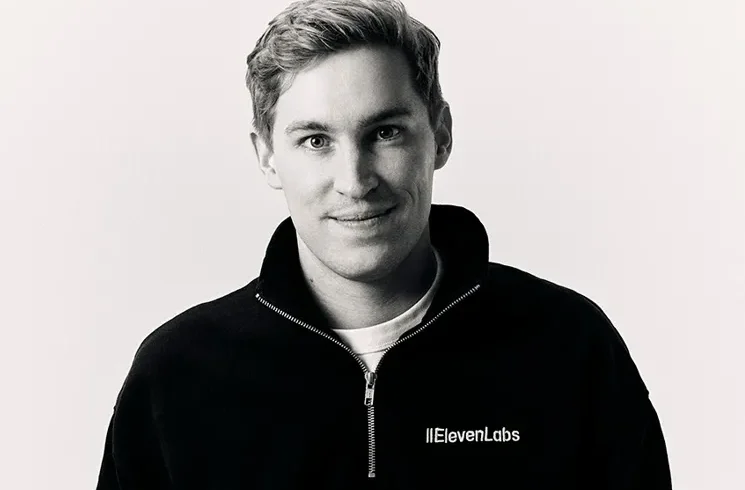

Mati Staniszewski was a teenager outside Warsaw when a small annoyance planted a big idea. Foreign films in Poland were dubbed with the same flat, emotionless voice for every character. The performances were lost. The question that followed him for years was simple: what would it take to break the language barrier entirely?
That question became ElevenLabs, the AI voice company Staniszewski co-founded in 2022 with his childhood best friend, Piotr Dąbkowski. Today, the London-based startup is reportedly in talks for a secondary share sale that could value it at $22 billion doubling its valuation in just five months, without raising a dollar of new capital.
From Palantir to a Company Named After Independence Day
Staniszewski studied mathematics at Imperial College London before working at Palantir, where he helped enterprises and governments adopt new technology. That experience taught him how organizations actually use software, not just how it’s built.
Dąbkowski brought his own engineering background from Opera Software, Google, and Tessian. The two had been friends for fifteen years before founding ElevenLabs, which they named for November 11th Poland’s Independence Day.
The timing mattered. When ChatGPT launched in late 2022, the pair saw that the technology to finally build natural, emotional speech had arrived. From that point on, ElevenLabs became the only thing either founder worked on.
A Narrow Bet That Paid Off
While major AI labs chased broad, multimodal systems, Staniszewski kept ElevenLabs focused on one thing: audio. That discipline shows up internally too the company has no job titles and runs on small, autonomous teams built on trust rather than hierarchy.
The bet paid off quickly. ElevenLabs raised $180 million in early 2025 at a $3.3 billion valuation, then $500 million in a Series D round led by Sequoia Capital that pushed its valuation to $11 billion. Total funding now sits above $800 million.
Enterprise Growth Behind the Numbers
The valuation is backed by real traction. ElevenLabs’ voice platform is now used by 41% of Fortune 500 companies, including the Washington Post, HarperCollins, Deutsche Telekom, and Revolut. Revolut’s rollout alone covers more than four million customers across 30-plus languages, cutting resolution times eightfold. Klarna’s deployment reaches 35 million U.S. customers.
Annual recurring revenue hit roughly $500 million in early 2026, up from $350 million the year before. A new partnership with Spotify is pushing ElevenLabs into audiobook production, tapping a market expected to grow from $5 billion to $35 billion by 2030.
The Bigger Bet
Staniszewski’s thesis is straightforward: voice, not text, will become the primary way people interact with machines. He’s said his goal has always been to build “a generational company” — an ambition that’s earned him a spot on TIME’s list of the 100 most influential people in AI.
That growth hasn’t come without scrutiny. As voice-cloning technology becomes more convincing, ElevenLabs has faced questions about misuse, and Staniszewski has repeatedly affirmed the company’s commitment to preventing abuse of its tools.
For now, the market’s verdict is written in the numbers. A company worth $3.3 billion eighteen months ago is now closing in on $22 billion built by two friends from outside Warsaw who started with nothing more than an opinion about bad movie dubbing.