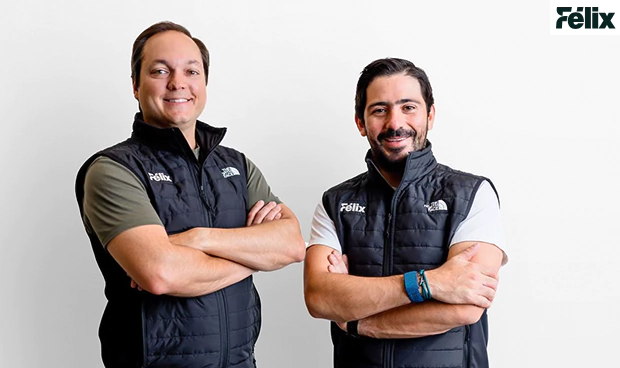



The Félix funding round just closed at $200 million. But only $87 million of that is stock.
The Miami-based fintech is best known for one thing: it turns WhatsApp into a money-transfer app. Immigrants use it to send cash home to family in Latin America. This month, Félix announced its Series C. Andreessen Horowitz led the equity part. QED Investors, Castle Island Ventures, Switch Ventures, Contour Venture Partners and Endeavor Catalyst joined in.
But the bigger number is on the other side of the deal. $113 million came from General Catalyst’s Customer Value Fund. That money is debt, not shares.
Add it up and Félix has raised almost $300 million since it launched. That’s a much bigger number than the round’s equity dilution suggests.
The pitch that got it there
Félix’s big idea was distribution, not new tech. Immigrants already use WhatsApp to talk to family back home. So Félix built its money-transfer tool right inside that habit. Users don’t need to download a separate banking app.
The company says it has moved more than $8 billion across eleven Latin American markets. Revenue has grown over 2.5x in the past year. Félix hasn’t shared a valuation. It only says the number has tripled since its $75 million Series B in 2025.
a16z isn’t just betting that remittances will keep growing. The firm is betting on something bigger: that conversational AI, stablecoin payment rails, and an existing customer base can become the doorway to more products. Think lending. Think savings. It’s the same playbook that has worked for embedded finance elsewhere.
Why the debt matters more than the equity
Here’s the part worth sitting with if you allocate capital for a living.
General Catalyst’s Customer Value Fund doesn’t lend against a pitch deck. It lends against real revenue and real transaction volume. Félix has that proof: $8 billion in processed payments is hard, measurable cash flow. A lender can underwrite that the way a bank underwrites receivables. It’s very different from how a VC underwrites a story.
That points to a bigger shift. Startups with steady revenue, payment volume, or lending assets are changing how they raise money. Smart founders no longer just reach for more equity. They build a mixed capital stack instead. Equity covers the parts of the business that are still unproven. Debt covers the parts that already produce steady cash flow. This approach protects ownership. It also stops a company from pricing its whole business off its riskiest, least-proven piece.
The read for allocators
Keep an eye on General Catalyst’s Customer Value Fund. This looks like at least its second big move into a late-stage fintech deal this cycle. Other growth funds will likely copy this model. More venture-backed companies are maturing into businesses with real, financeable cash flow and funds want in on that.
For LPs, this matters too. A VC fund’s returns now depend on more than picking the right companies. They also depend on how well a GP can structure debt alongside equity.
The headline says Andreessen Horowitz backed a $200 million fintech round. The real story is simpler: more than half that money wasn’t venture capital at all.